Episode Transcript
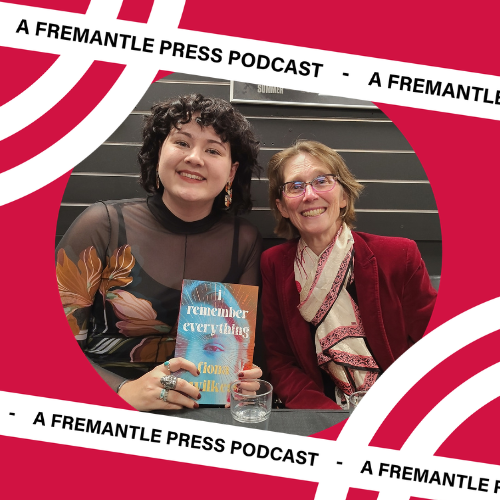
[00:00:14] Speaker A: Please give another warm welcome to Fiona and Georgia.
[00:00:22] Speaker B: Thanks, Bianca, for warming up the crowd. I'm sure that without that, you know, Fiona wouldn't have felt the love so much, but yeah. Fi, before we begin, I'd just like to ask you. You're a teacher, you talk about other people's books all the time. Here you are, this is your book. You're talking to people about your book. What's the difference?
[00:00:41] Speaker A: It's a lot scarier, I think. Yeah, it's getting easier as I teach to walk out and say, well, if you don't like the book, it's fine. Just try and think of something interesting to say about it. And I think the same applies with this one.
But, yeah, definitely kind of a bit more nerve wracking to sit in front of everyone I know and talk about something that I made. It's exciting, but it's scary.
[00:01:08] Speaker B: Yeah, that's really. It's quite a vulnerable moment, isn't it? To have been by yourself and writing it and then suddenly it's out in the world and it's not in your hands anymore. But that's also a marvellous thing and you are going to love this book.
There were a couple of paras that I just wanted to read you first up to take you into the book. Can you hear okay there, everyone? Yep. Good.
When I was a teenager, I thought that love was grand gestures and heartfelt speeches.
Then when I was growing old too fast with my friends, I thought it was holding hands in hospital beds and reading aloud.
Now I think it is familiarity and comfort.
It's throwing them your coat when you walk into their home without waiting for them to offer to take it. It's taking a sip of their drink, a drag of their cigarette, the spare change for a bus ticket from their jeans pocket, knowing there'll be no demand for repayment.
In those early days of adulthood, we all set in stone the foundation for a love like that.
In fact, I do not think it's overstating things to say that in those first weeks of university, my friends and I fell head over heels in love with one another.
Sophie, it's an extraordinarily ambitious thing to write and to have us come to care about a whole group of people.
What were your intentions in writing the book that you did?
[00:02:33] Speaker A: I kind of set out wanting to write, I suppose, an ode to queer friendship which has been so important in my life and kind of feeds my soul in a really specific way. And I think I did that to a certain extent. I think the love Story at the heart of this book, unlike in a lot of kind of coming of age books, is not necessarily a romantic love. It's a love between Billie and her friends, which is, you know, how I experience friendship. And I feel very lucky to experience friendship that way. But then as I was writing, it kind of grew from there and it was more so.
I wanted to not only write this kind of ode to queer friendship, I wanted to write an ode to the generation of queer people before me who did not get to kind of live their lives to the fullest. And so my intention with all the characters was to try and make them feel alive and to make them live before there is sort of. Of those inevitable hardships that come up. And having queer joy exist alongside queer tragedy was really important to me when writing this book.
[00:03:47] Speaker B: Would you like to take us directly into an early university scene?
Because I think here Billie is 18, isn't she? Yeah. Yeah. So this is the very beginning.
[00:04:05] Speaker A: I have never in my life spent so much time intoxicated as I did in that first semester of university. And that was almost entirely thanks to Robert. Although we all egged one another on from a desire to always be on the same wavelength and to always be having fun.
On weekends, but especially Friday nights, we would go out in town. The girls, Laura, me, Elle Valentine, in that first year at least. And Hen Dave and later Aggie and Clarice would gather in one of our rooms and spend an age getting ready. We cooled our wine on the windowsill, frigid air blasting inside and raising goosebumps on our bare legs because the shared accommodation fridges were glorified petri dishes rife with germs and theft.
When we were suitably tipsy and our hair was bigger than should have been gravitationally possible, we staggered giggling out of our building to hurry to the bus stop. We would climb aboard the 923 bus and find the boys, Robert Tolstoy, Cherry, and later Ted and Arthur, waiting for us in the backseat.
We'd tumble about as the bus moved before we made it to our seats, falling into the boys laps.
Our nights were spent in toxic clouds of perfume, hairspray, body glitter and cigarette smoke. We danced for hours, screamed along to songs we barely knew the words to, but soon came to adore. The bands that sang them Adam and the Ants, Susie and the Banshees, the Police, Blondie. They soundtracked our first year of university.
Thank you.
[00:05:33] Speaker B: I was in the 80s. I know you weren't there.
Believe it or not, when I read this book as the Hungerford, you don't know who the author is, and all you've got is a manuscript. And I thought, this person, you know, they've lived through what I've lived through. How did you.
What sort of research did you do? How did you immerse yourself in the 80s?
[00:05:55] Speaker A: I think there is sort of something really enticing about the era in which your parents were teenagers. You know, you kind of.
You seek out little insights into who they might have been before they were parents. And the 80s, I mean, it's a kind of magic time in a lot of ways. It was a period of real vibrancy and fun.
But also, in the UK at least, it was a time of extremes, economically, politically. We're talking about the Thatcher years, which weren't easy for a lot of people. And I think that kind of mix is really interesting.
And the ways it kind of would have impacted people like me.
In terms of research. I mean, I approached it the way I approach a lot of my research, which is just. I just read as much as I possibly could, and I went for memoirs a lot of the time to try and get a sense of what it felt like rather than just the facts.
So I approached it as a historical novel.
But then at a certain point, I kind of recognized that there would be things that I got wrong no matter how hard I tried. And I had to kind of put the research to one side and just write and write these characters as sort of authentically as I could, and write them, you know, in the way that I know queer people to be. And, you know, there are. There are echoes of people that I know in these characters, although, you know, they're not based on anyone. I know it's all of you.
[00:07:24] Speaker B: Buy the book.
[00:07:27] Speaker A: So, yeah, just trying to approach it sort of carefully and respectfully, but also kind of acknowledging that I can't get it perfectly right, I think.
[00:07:39] Speaker B: Did you. Did you listen to it? Did you have a soundtrack while you were writing?
[00:07:45] Speaker A: Yeah, I mean, I listened to a lot of 80s music anyway, so my usual kind of playlists were on. And then the playlist that I was playing just before, when everyone was cycling in, a lot of the songs on that playlist were going through my mind as I was trying to write, and especially for kind of scenes where they're all out dancing at the clubs or. Or whatever.
[00:08:06] Speaker B: Yeah.
I think when I was in the 80s, one of the things that was apparent was that gender could go either way visually, but there was no language around it.
Like, there literally wasn't anything to Say, so what do you think the importance of finding words for that kind of time is?
[00:08:37] Speaker A: Yeah, I think that was. That was one of the benefits of writing it from the perspective of someone who had kind of grown up and was looking back on the time, is that I was able to use the language that feels right to me and feels authentic to me, whilst acknowledging that it kind of didn't exist at the time.
I think the fact that we now have sort of words that we can use, and it's incredibly important, it's really validating. It allows people to kind of get sort of comfortable in identity, but also kind of when one label doesn't work for you, you know, you can switch them in and out. And it's very freeing.
So there is kind of.
It's really.
I think it's a special thing. And, you know, sometimes people get, you know, why does everyone have to have a label? Why do we have to be stuck in a box? And I think, well, actually, you know, sometimes the box is safe. It's protective, and it allows you actually to sort of explore with a little bit of. Sort of a, you know, a little bit of safety around you.
[00:09:38] Speaker B: And so where and what scenes did you begin writing?
Like, where did the book begin? Because it has a Covid frame.
But was that always there?
[00:09:52] Speaker A: No, no, the framework of COVID came very late. Although I started writing the book kind of after, I think, sort of 2021.
And I realized that the book was missing something. And initially it only kind of took place in the 80s, and it was just like a bit of a bummer. Like it was just not really working. It was just kind of sad. And so I wanted to.
I needed Billi to be reflecting on this time and having had a bit of time to process everything that is happening and kind of as she's doing that, I was kind of doing that in having lived through a pandemic, which is kind of a weird thing to do. And I think it does take people a while to process it.
And I had these moments of kind of really reflecting on how lucky I am to have lived through the one that I did, where people sort of, for the most part, tried to do the right thing and guidelines were put in place and protections were brought out and there was information and education coming out every day, which was not the case in the 80s. So bringing it, you know, around and using Covid to kind of hang this other story on was really helpful. But it was a late. A kind of late edition. Yeah.
[00:11:15] Speaker B: A fortuitous arrival of a terrible event. But did that change that you. The way that you thought about the HIV AIDS epidemic and how it was received and the sorts of conversations that might have been different?
[00:11:33] Speaker A: Yeah, I think there was a meme going around when Covid first kind of started happening, when everyone was put into lockdown and it was sort of, you know, everyone is freaking out and, you know, oh, my God, the government isn't doing anything. And it was a queer person being, like, first time, you know, like, it's just.
Yeah, people cared this time and, you know, within the community, people cared and people were doing their best to look after each other, but more widely, it was just ignored. And, you know, if we're talking about sort of the importance of language, there was a lack of language and a lack of education around HIV and aids, which had a devastating impact. And if there had been more, as I say, education, a lot less people would have died and we wouldn't be missing such a huge kind of part of our community.
[00:12:28] Speaker B: Because the.
I mean, the thing I still remember and being freaked out by is the Grim Reaper ad and that just that public message of be terrified everyone. But then that's actually getting at a group of people. It's marginalising in a dreadful way.
A lot of your book is actually about the importance of caring, isn't it? Do you want to talk a bit about that?
[00:12:55] Speaker A: Yeah. I mean, the book is about community and I think you can't kind of keep up a community unless you kind of feed into it and you care for one another.
And there are. There are people in this book who are not really trained to care for others, whether that be sort of medically or emotionally. But they had no choice. You know, their friends needed them and they stepped up. And a lot of the time, other people turn their backs, you know, families turn their back, some people. And the only people left to look after you were your friends. So community is deeply, deeply important in that sense.
[00:13:34] Speaker B: And.
[00:13:35] Speaker A: But then, you know, towards sort of, you know, when we're looking back at this time, Billie has lost a lot of her community and feels very lonely.
And it's really a process of her sort of returning to thinking about the community that she did have as a way of healing.
[00:13:56] Speaker B: And I think you said to me at one point that there's a reason that Elle is at the start of lgbtqi.
[00:14:07] Speaker A: Yeah. So before the AIDS crisis happened, the acronym was glbt.
The T was quite often left off, which is an issue in itself. But after the AIDS crisis, or as it kind of progressed, the L moved and it became lgbtq, et cetera, et cetera, because of the role that queer women played at this time.
They nursed their friends, they donated blood, they, you know, sat with people they didn't even know as they were dying just because that person had no one else to sit with them.
You know, the kind of emotional labor that they did is often kind of ignored, but it was deeply, deeply important.
And it was important to me that I show that in the book.
And in the same vein, there is sometimes this narrative that only gay men died of aids or they only gay men got hiv, and that's not true.
A lot of straight people got hiv. A lot of queer women got hiv.
So trying to kind of write their stories back into existence in some ways was important to me as well.
[00:15:24] Speaker B: And going to that research, did you. What. What did you learn or what did you discover that you hadn't known before?
[00:15:32] Speaker A: I knew embarrassingly little. Like my, my. I was severely under educated about the AIDS crisis. I knew that it had happened, and I knew that a lot of gay men had died, and that was kind of it.
And I was really disappointed in myself when I started doing the research of just how little I knew.
It is a horrendous way to die. It is so awful.
And, you know, we are missing so many people because they contracted it and they died.
And so it's the. But it's the kind of thing where I will continue to learn about this and continue to learn about queer history generally. It's a lifelong education, but yet the little that I knew, finding out how little I knew was kind of the biggest thing that I found out was that. That complete lack of knowledge.
[00:16:26] Speaker B: So then what? I know I asked you this before, but if you knew so little, what was it that was prompting you or driving you to send Billy and Laura off to university and knowing that they were heading into the.
This crisis eventually? What was it that was driving you there?
[00:16:45] Speaker A: I think it was just that I.
I knew that I was missing something. And what I was missing was a lot of queer elders. There's a whole generation of people who are not here. I didn't know any queer people growing up. I don't know that many queer people who are older than me now.
And they're. They're people that I feel, I think I needed.
And so I kind of became interested in that absence and started wondering, you know, well, what are we missing? What kinds of people are not here and why? You know, and so I also, again, it was that thing of, you know, sometimes queer Characters are written in to die, and I was getting quite frustrated with that. And so I wanted to see if I could write about queer Joy without sort of erasing the tragedy and the hardships that often accompany being queer.
And, yeah, this period of time felt sort of natural to try and do
[00:17:46] Speaker B: that with, because then you've got the magnificent Aunt Sarah, who. I love Aunt Sarah.
What does she represent in your book? And you might want to say who she is, too.
[00:18:02] Speaker A: Aunt Sarah is the best person that has ever existed that doesn't actually exist.
She is.
She's an older lesbian. She's the aunt of one of the characters, and she's kind of very eccentric, and she just kind of exudes this. This fun and joy. And she arrives at quite a dark time for the group of friends and just kind of takes them under her wing and looks after them.
And it was really important to me that Billie had someone that she could look up to and turn to as an example of the kind of life that she could live.
Sarah has had a difficult life. There are things that, you know, have happened to her that are awful. You know, she kind of came up before homosexuality was legalized in the uk.
She lost friends in different ways, but she doesn't let it rule her. She decides that she's going to live and live loudly and live with Joy at the center.
And there are other characters in the book who don't necessarily do that, and they in some ways, give up in the face of hardship.
But I really. I just needed Billy to have someone that she could look to and say, oh, you can grow up gay and happy. You can grow up full stop. You know, you don't have to. You don't have to suffer.
So, yeah, I'm very. I'm very fond of Aunt Sarah as well. She's very important to me.
[00:19:33] Speaker B: Yeah, and to me, too. What, What?
I mean, do you yourself feel as if you don't have enough elders in your life? Because a lot of. A lot of your characters have left a family, haven't they, and then have created something new.
Where do you see yourself in relation to what happens to them?
[00:19:57] Speaker A: I think even if you come from a very supportive family, as I do, I think there's a real magic to your chosen family and people that live the same way as you do and understand you, but when you are kind of peers with those people, so sometimes you're kind of looking at the future and going, I don't know what it looks like.
And that's really scary.
Even, you know, I mean, I'M very fortunate to have grown up in sort of the years that I have grown up in that, you know, you have gay people on TV and people are out and things like that. But it's difficult when you don't have someone kind of right alongside you who has done life already. Right. It's when you are figuring out that you're queer, it is really scary to go, well, what do I do?
Do I just not get married? Do I not have a family?
Am I going to die young? All of these things that just play on your mind, and some of them might be unrealistic anxieties, but some of them are true. And it's really difficult to sort of grapple with that and not know where you're headed.
So having someone that has already done it and can serve as an example to you is really powerful. And I think a lot of people in my generation and in previous generations just haven't had that.
[00:21:20] Speaker B: Does that make you think about the sort of elder that you. You can be?
[00:21:26] Speaker A: Yeah, I hope so.
I think so. Yeah. I.
Yeah, I think community is very important to me. And I think what I try to sort of be my authentic self in the world and hope that, you know, as people younger than me sort of start coming up and, you know, hopefully I can kind of be part of their lives and be part of their community as I age. And, yeah, I mean, it feels like a lot of pressure to be a role model, but I will do my best.
Yeah, that's what I would hope for is that I.
I just want to. Yeah. Grow up and live a happy life and hope that that can serve as an example to people who maybe wouldn't see it otherwise.
[00:22:15] Speaker B: The other thing I like about Billie is that she's desperately in love with her best friend, Laura.
Would you like to talk a little about unrequited love?
[00:22:26] Speaker A: No, I wouldn't.
No. I think, look, we've all been head over heels in love with someone that didn't care.
But what I think is really beautiful about Billy and Laura's relationship and friendship is that Laura really does love Billy, too, and they're able to kind of live together and sort of serve each other and be incredible friends to each other. Even though there is this kind of unrequited love there, it never gets in the way of. Of their friendship.
And I think it does really serve Billi in a lot of ways to have this person who she kind of pines for because it keeps her. Keeps her there, it keeps her close, and it allows her to the Kind of the way she throws herself into love is the way she throws herself into friendship. And sort of she doesn't expect to get anything back, but she so often does, which is really beautiful.
[00:23:28] Speaker B: It keeps the reader secretly hoping as well, What was it like and what difference did it make for you that you were shortlisted in the Hungerford Award?
[00:23:43] Speaker A: Yeah, I mean, it made a huge difference, even just to the writing process, because I sort of saw that the Hungerford was coming up and I had a manuscript that I thought was okay, but wasn't up to the standard of where I wanted it. So I decided that I would use the Hungerford deadline as a personal deadline to get a manuscript together that I. I thought was okay.
And that's what I did and then submitted it and was very, very lucky to be shortlisted and.
And then to get a contract even though I didn't win. So it's. Yeah, it's changed my life completely and I'm. Yeah, I'm really, really grateful for that experience, even just for the push to sort of finish the manuscript.
[00:24:24] Speaker B: And has that given you access to a different kind of community too, or broadened your writing world?
[00:24:32] Speaker A: Yeah, I think so. I mean, a lot of my friends are writers anyway, but I think we're all a little bit private about our writing. We can be a bit sort of cagey about it and we're very, very supportive of each other, but sometimes a little hesitant to share. So being being kind of welcomed into a larger creative writing community, which is very open and supportive, has really helped me get more comfortable talking about my writing. I was always a little bit shy about it and sort of, you know, it was something I did sort of behind closed doors, I did not do this.
So to be at the point where I feel supported by a community from all aspects of my life, including sort of people I've met more recently through Frio Press, has been really. Yeah, it's been magical.
[00:25:19] Speaker B: And so you teach creative writing sometimes. Sometimes as well.
What did you learn from the editing process?
I saw how hard you worked and how open you were to it. What did you learn that you would take out into the world in a sort of mentoring, teaching way?
[00:25:39] Speaker A: I learned that I cannot spell.
No. I think there's a lot of things which, you know, you might sort of really love that just don't work and they don't serve the overarching story and sometimes you just have to kill your darlings and it's painful and you get really mad about it and then you do it and it is better and then you get mad that it wasn't. That it wasn't good to begin with.
But you come out of the editing process a much stronger writer and kind of going into future projects and writing. I can kind of in some ways Hear your voice, Georgia, in my head going, you've used that word 17 times.
You need to choose another one.
So I think, yeah, being a learning how to be a better editor has made me a better writer.
[00:26:31] Speaker B: Are you gay? More willing to talk to us about what you're working on now?
[00:26:37] Speaker A: No,
[00:26:40] Speaker B: no.
[00:26:40] Speaker A: I'm a little bit superstitious and I don't like to sort of say too much too soon because then it just won't get written. But I am working on new stuff and I'm excited about it and I hope I will be able to share it at some point in the nearish future. But it's still early, early stages.
[00:26:57] Speaker B: Does it, does it feel like a different you who's entering a second book as a writer?
[00:27:03] Speaker A: Yeah, yeah. I mean, it's been such a long, very fulfilling, but very long process of sort of when I finished the book and entered it into the Hungerford. I mean I was.
I think I was long listed when I was 24. No, 25, and I'm about to be 28. So that's. That's quite a big chunk of time for me. And so I've grown a lot as a person and grown a lot as a writer.
So yeah, I feel like I'm going into a second book as a grown up, whereas I feel very much. I was sort of still in some ways a bit of a teenager when I was. When I was starting this book.
[00:27:39] Speaker B: Yeah.
I think one of the really interesting things about your process is that you can't actually account for the life things that will take place as you write a book. So you don't even know what that thing is to become because you're working and living at the same time. So part of it has to be organic, doesn't it?
[00:27:57] Speaker A: Absolutely, yeah, absolutely. I think it's.
Yeah, I don't know. And that's part of the reason I don't like to speak about stuff of works in progress is because what it looks like now, it will look completely different by the time I think it's finished and then it will change shape another sort of four times as I'm editing it. So there's no point kind of saying, oh, it's going to be about this, this and this, because I don't know who is actually writing that book yet.
[00:28:25] Speaker B: I think that's a useful thing to know about the process and to be accepting of the process, that it just is what it will be to what. What do you hope that people will feel when they read your book? And is it okay to make people cry?
[00:28:48] Speaker A: I hope it's okay. Yeah. I didn't really think about the ethical implications of it, but it's too late now. Yeah, I think.
I think it's okay to make people cry. Life is painful and it's sad and it sucks a lot of the time. This is very hopeful. It sucks. It really does.
But we can't ignore the past because it's painful to think about.
And I think sometimes if you care enough about these characters that you are sad when something happens to them. I think that is a real. That's a feather in my cap. But I hope that people don't walk away from the book thinking, that was really depressing.
I hope they walk away with a little bit of hope. I hope that people kind of walk away with the impulse to look at the past and reconsider sort of their place in the world and their place in queer history, because everyone has a place in queer history.
But also to look to the future and think, okay, we can do better and we can take care of each other and we can go to protests and we can advocate for change and we can. Yeah, tell our friends we love them while they're sitting in front of us.
[00:29:56] Speaker B: And I think that's the way that stories are powerful, isn't it? In that maybe a news article and some statistics aren't.
Do you feel that stories can change how people feel about the world?
[00:30:13] Speaker A: I think so. I think that's the only way I kind of learned to care about the world because I have no head for statistics.
I don't care.
If you sort of tell me that something matters to you and you tell me why, then it matters. And I think that's what books have always done for me. They open me up to different perspectives and different worlds and introduce me to different people who I care about, even though they are completely different to me. And yeah, there is. You know, there's a reason people kind of say that books are magic, and it's because they are.
[00:30:45] Speaker B: And one of the things I love about this is that Billie herself is a literature teacher.
And so you've got all these books that they're reading and discussing throughout. And you've structured this with a nod to Dickens as well, haven't you?
[00:31:02] Speaker A: Yeah, I just thought it would be really funny.
I haven't read that much Dickens.
I've read very little Dickens and I think that's fine.
I wanted.
I'm not mad about it.
I think the.
What I liked about that framing.
And there's another sort of a recurring kind of motif of Anna Karenina, which Billie thinks she's going to read at university. And she doesn't end up reading until much, much later.
And she's kind of like, that's not what I expected.
And I think the thing is, when you are young and optimistic and heading off to university, you think your life is going to look a certain way and it never, ever does. It's not like the storybooks, it's not like Dickens. But that's fine. Not everything has to be Dickens.
Sometimes it can just be this.
Or Anna Karenina.
[00:32:00] Speaker B: Yeah. And keep an eye out for the Anna Karenina motif as you go because it's just lovely seeing where that book keeps popping up throughout.
Would you like to read us a little more to close out our conversation?
[00:32:18] Speaker A: Yes, I would. I'd also just like to say, before I do, thank you all for coming.
It is really nice to see you all here. And a lot of my thanks are in the acknowledgments of the book. So I'm not gonna kind of bore you all now, but it is a book about community. It's a book about caring for each other and showing up for each other.
So the fact that you are all here means a lot to me.
So thanks. Okay, so this is a conversation between Billy and one of her friends, Ted, when they are still at university.
I was sitting in the corridor of Robert and Tolstoy's accommodation block, nursing a bottle of wine all to myself, when Ted slung himself down next to me. It was the early hours of the morning, yet the party raged on. Several smaller parties, pre drinks for big nights out, had filtered out into the corridors hours before and had meshed together into a swarm of people. Nobody had actually made it out to the clubs. Ted rolled onto his side and blinked up at me without speaking. I handed him the bottle, from which he took a generous swig. What are you going to do with your life? I worked hard to focus my eyes on his face. What do you mean? Exactly what I said. I. Well, I'd like to be a writer. I slurred. No, no. He sat up. Say it with more determination. Say, I'm going to be a writer. He blurred before my eyes again, but his message was clear as day. Okay. I'm going to be a writer. Excellent. Now ask me I grinned. Enjoying the game now? What are you going to do with your life, Ted? I'm so glad you asked, Lady Day. First I'm going to move to Paris. I'm going to live in a garret, you know, one of those dingy artist studios. And I will be broke. He paused to burp and blew out a slow breath, trying to work out if he was going to be sick. Content that he was all right, he continued, but happy. I'm going to drink a lot of red wine, obviously. He shook the bottle in my direction. The sloshing sound made my stomach clench. And I'm going to spend my days embarking on passionate affairs with interesting men. A new one every month. I think that will take up a lot of your time. Yes, but it's a sacrifice I'm willing to make. But that's not all. No? No. I'm going to be a writer, too.
A small part of me sagged at his pronouncement. Ted was, in my eyes, good at everything he did. I had no doubt that if he wanted to be a successful writer, he would become one, and probably much sooner than I did. I would become the copycat, the tag along. And I had horrible fears that his work would be much better than anything I could ever produce. But his eyes were shining as he told me the story of how his life was going to happen, and I couldn't help but hope it all came true for him.
Oh, yes, yes. He lifted his hand and twined his fingers into his hair. He had a habit of doing that when he was talking. I watched his fingers tighten and then relax, dropping back to his side. Ted had strong fingers, strong arms, and intelligent fingers. I first read that phrase, intelligent fingers in a Mary Gaitskill story when I was well into my 30s. In the past, I might have wondered what was meant by it. Instead, when I read those words, Ted's long, thin fingers handing me a cup or pointing to the crossword clues in the weekend paper shone in my mind. The image was so clear, so fresh, that I could barely believe it had been nearly 15 years since I'd last held his hand. What were you right about?
With a flourish, Ted leaned over and kissed me on the lips, smiling against them. When he pulled back, he exhaled in one quick gust. Everything.
[00:35:52] Speaker B: And I just love the way that this is a book full of dreams, hopes and dreams. And I think that's what I took away in the end. And it is hopeful and it's glorious and congratulations. I would like to declare this book launched, And I would like to thank our magnificent hosts planet as well for creating this space for us, and I'm sure that the author will be very happy to sign a copy or two.
I was at a launch earlier where earlier this week where it was said buy one for your friends and buy one for your enemies too. So take, take, take heart and take note and thank you all so much for being a lovely audience and you will enjoy this book when you read it later tonight.