Episode Transcript
[00:00:00] Speaker A: Foreign.
Hello and welcome to the Fremantle Press podcast. Today we are recording in Wol Yulup on Whadjuk Nungar Puja. And I'd like to acknowledge our first storytellers along with Noongar elders past and present.
My name is Holden shepherd, former winner of the Hungerford Award for my book Invisible Boys.
I'm here with publisher Kate Sutherland to introduce you to one of four writers shortlisted for the 2026 Hungerford Award.
Being on this shortlist and then winning was a huge moment in the development of my own career and it's so exciting to see other authors now following in this process.
Today's guest is David Harris, whose manuscript is a work of literary fiction called Moments in the Dust.
First up, can Kate, could you describe why you and the judges chose this manuscript for the shortlist?
[00:00:55] Speaker B: Yeah. Thanks, Holden. This novel really stood out for us for the strength of its writing. This author knows his craft. His sentences are beautiful, his dialogue is strong, and he ends and exits scenes with panache and flair. We love the visceral evocation of country life and cattle mustering. It's hot and dirty and you really feel that on the page. It's also a useful environment to explore relationships between men, mates and father and son in particular.
[00:01:24] Speaker A: Thank you, Kate, for those comments.
And now to introduce our author guest for today.
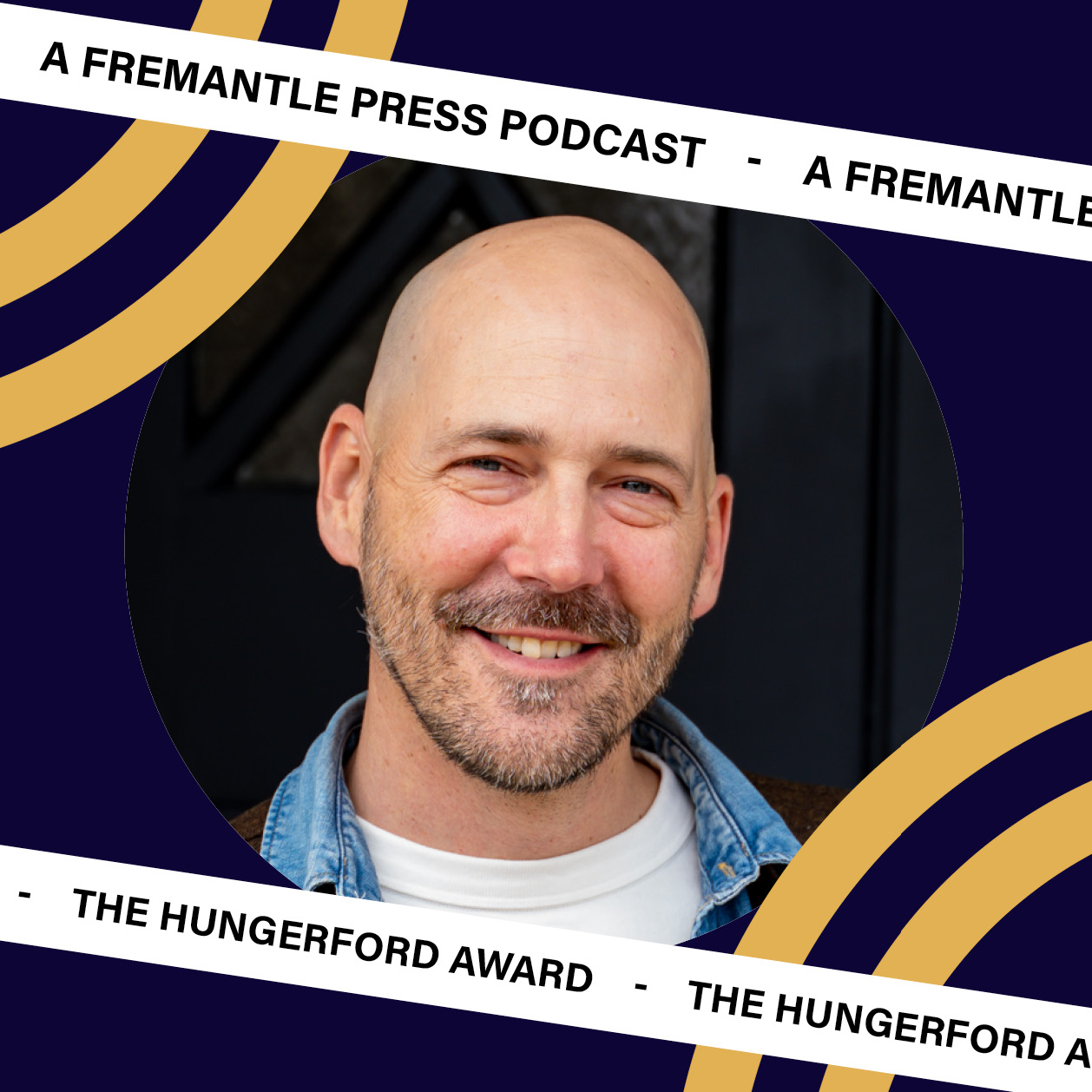
David Harris is a Western Australian writer whose fiction explores memory, family and the uneasy relationship between people and the places they are from.
David won the inaugural Best Australian Yarn Short story Prize in 2022, where he was again shortlisted in 2024.
In 2025, he was selected for the Writing WA Emerging Writers Program, and earlier this year, he was shortlisted for the Firphy Literary Award.
His work is often grounded in the landscapes of Australia and coloured by his own distinct perspective, shaped by parenthood, public service and time spent on country.
David, welcome to the podcast.
[00:02:07] Speaker C: Thanks for having me.
[00:02:09] Speaker A: Congratulations on getting this far. How do you feel?
[00:02:12] Speaker C: It's humbling. Yeah. You could probably attest to it. It's a little uncertain at first, knowing how to contextualise it when something happens sort of outside of your own experiences, just finding the right context to place it in and process it.
[00:02:27] Speaker A: But very exciting, no doubt, to be on that short list.
[00:02:29] Speaker C: Very exciting. And thinking about, like, Fremantle Press and some of the names that have passed through the imprint in the past. Not only yourself, but I guess people like Tim Winton and Robert Drew and Elizabeth Jolly and like, massive, massive names, they're heavyweights. So, yeah, awesome.
[00:02:42] Speaker A: Fremantle Press are an incredible publisher to work with and it's amazing to just even be on the shortlist 100%. An award like this is a really important milestone for a writer's own career journey as well. So what was it like for you to discover that you were on the Hungerford Awards shortlist?
[00:02:58] Speaker C: Yeah, we did a little bit of phone tag. I think I missed a phone call at first and I googled it like you do these days, and saw that it was Claire from Fremantle Press, and we went back and forth a couple times. I was expecting the call to be the usual, thanks, but no thanks. It's not you, it's us. That sort of thing. To get the good version of that conversation was great. And just for it to be Fremantle, someone that knows literature and understands career pathways and that sort of stuff as well just, I think, makes it a little bit extra special.
[00:03:24] Speaker A: It's so exciting to get that phone call and to not get the quiet email 100% instead.
So, David, let's talk about your book. Let's explore that. Could you tell us in your own words what your novel is all about?
[00:03:39] Speaker C: Yeah, look, it's about two best friends from the mining town of Kalgoorlie where they've grown up, and they leave and head into the far north of Wa to work on a cattle station.
I guess I frequently make the distinction, though, between sort of what happens and what it's about. That's what happens. What it's about is generational trauma, survivorship, toxic friendship, young people trying to find the context for what it means to be an adult, in truth, for what it means to become a man, in truth, with all the inputs that you have flying at you in life, to become an adult and to become a.
And that's very much the struggle at the heart of this narrative.
[00:04:15] Speaker A: It's so great to make that distinction as well. Readers always want to know the plot, but they do also want to know exactly what you said, what it's about at its core. And it sounds uniquely Western Australian, with cattle stations as the setting. So when you're ready, could you perhaps share a reading from Moments in the Dust and maybe just give the listeners a tiny bit of context to start off with of, you know, where this fits into the manuscript overall?
[00:04:37] Speaker C: Yeah.
[00:04:37] Speaker D: I'm gonna read a section that's kind
[00:04:38] Speaker C: of late in the narrative where my main character Beau's sort of wrestle with some sort of internal stuff and process sort of what it means for him and what comes next.
[00:04:49] Speaker D: He woke in the early morning and made himself a strong black coffee, which he drank alone beneath the eaves of the ringer's quarters. He showered and then he shaved and changed the dressing on his forearm. His saga was mostly healed, and though he was beginning to look better, he still wasn't sure about the face that looked back at him from the mirror. What truths and what portents were written upon him?
What lessons had he learned? He thought about how every moment of his life had led to this one, and how it wasn't like a map.
He could see where he'd come from and he could see the wrong turns that he'd made along the way, but he couldn't see where he was going by some manner of sorcery or telepathic understanding. The horse was waiting for him at the head of her stall. He saddled her and fed her by hand as he spoke, low and soft, and the only other sound was the jangle of the bit.
He led her north of the homestead, where he mounted her and rode out into the morning.
All around in the country had grown bright from the rain, different shades of green in the long grasses and in the foliage in every direction, the colours of flowers that bloomed brief and bright in defiance of the odds.
He listened to the wind, which was the only sound not of himself, and he watched the arcing of scattered clouds as they left their tracks upon the sky.
His hand was light on the reins, and more often than not he let her choose her own path. She wandered while his mind wandered, drifting across memories of his sister and his parents and Bumby and Chloe and everything in between.
By noon he was far from the homestead and following the remnants of some forgotten and overgrown track.
He looked out along that road and thought of those who had travelled it before him and how their number was perhaps less than any other road could claim, so wild, so distant from all traces of what men call civil. He thought of those who had died upon such roads and of all the manners of their passings. But more, he thought of those who might have come upon them, if at all, and what they might have made of such a thing, and if on coming upon bones or desiccated flesh, or even only dust, by what mechanism might they have determined their ruin?
He rode until the afternoon grew long, searching for some sacred and elusive truth.
He rode until he found himself far from any construct and there was no trace of civilization, for none had been here save those who had trodden barefoot through a land which holds sway over their survival.
If he was still enough, he could hear the ghosts of their passing, but they spoke a language that was not his own. And their secrets were lost to him.
He rode until his face was blue with dusk, and then he dismounted and left the horse cropping at the long grass. While he stood with his thoughts, he could feel the whole world wrapped around him. And he knew then that every man and woman and every child was at the center of their own universe. You could never come to the end of anything. The story went on in every direction, and there were 360 degrees of opportunity waiting for him.
Every step was a step into the frontier of your own life. Every future was a world unknown, and going home was still going forward.
[00:07:29] Speaker A: Thank you so much, David, for sharing that piece from your novel.
I always respond well to those metaphors of nature that also say something about the protagonist. In that moment of the flowers blooming in defiance of the odds is a really beautiful image.
And the setting certainly lends itself to the introversion of your protagonist.
Let's talk a little bit about craft and about different forms. So you've already enjoyed some success as the award winner of Short Story Awards, Best Australian Yarn. We first met, I think, at the Armidale Writers Award many years ago. I was the judge and you won. You went on to again win the Best Australian Yarn. You've done so well in that space as a short fiction writer, and your writing is very powerful. Novel writing, too, obviously requires a lot of attention to the craft. So what is the difference for you in shifting between that really long track record of established short fiction and now writing into the novel space?
[00:08:24] Speaker C: For me, honestly, not a lot of
[00:08:25] Speaker D: difference, to be honest.
[00:08:28] Speaker C: I think it's because of the way
[00:08:29] Speaker D: I go about my writing.
[00:08:30] Speaker C: I'm definitely not a planner. I don't sit down and like, I never do a beat sheet. I never figure out what the structure of my narrative arcs are, anything like that. I've tried in the past A I get a headache from it and makes writing not fun, baby. On the times where I have tried to do that. In doing that, I kind of lose the fun of writing. I kind of like being the first person that finds out what happens in the story. I approach my storytelling the same, I think in each instance, concept setting in which I can anchor the theme and then I add a character and then I don't know the character yet. So I add a layer and I add another layer. And in the adding of the layers, I get to know the character, which means I get to start asking the question, why are they there? Which helps me start unpacking the theme of the piece. And I just kind of build and Layer it as I go along.
I guess the only change in process is there's a greater number of layers and a greater number of complexities that go along the way. So it makes it more challenging just making sure everything ties back to something. But in terms of the process, I don't think a lot really changes.
[00:09:29] Speaker A: That's interesting about the layers and also, I think you've hit the nail on the head about the intuition and the gut feel as you're writing. If the magic isn't there and it's not fun anymore, suddenly it becomes, okay, why am I doing this? You know, if it's overly bland. So you're definitely a pantser by the sounds of it.
[00:09:42] Speaker C: Absolutely, 100%.
[00:09:44] Speaker A: Now, what is it about Western Australian people and places that you're drawn to write about?
[00:09:50] Speaker C: Setting's that first opportunity for you to really ground the theme and to make the reader feel comfortable.
And Western Australian landscapes are kind of our version of the frontier almost. And I'm drawn frequently back to frontier storytelling. It interests me. A lot of characters, when they're going through things, are kind of stepping into their own frontier.
Yeah. I can ground my themes in the rich variety of landscapes we have in Western Australia. Just gives me, like a really cool playground and a really interesting palette to paint with, I suppose.
[00:10:20] Speaker A: Yeah. Very richly evocative. And also, as you say, if the setting can do that, legwork that helps illustrate things for your reader. David, thank you for all of this. Is there anything else that you'd like to share with our listeners today?
[00:10:34] Speaker C: Just my gratitude. I think the idea that my name's out of consideration by an imprint that understands literature and career pathways for authors and does such a good job of supporting their talent is. Yeah, it's cool just to even be in the conversation.
[00:10:48] Speaker A: It's an amazingly exciting time, so well done and congrats, David and Kate. Thank you both for being here. David, thank you for sharing more of your manuscript. Moments in the Dust.
Listeners, you can meet David at the 2026 Hungerford announcement at Walghilup Civic Centre, City of Fremantle Town hall on Friday the 16th of Octo.
Tickets are free and available from the Fremantle Press website. I'm Holden Shepherd. Thank you for listening.