Episode Transcript
[00:00:00] Speaker A: Foreign.
[00:00:09] Speaker B: Hello and welcome to the Fremantle Press podcast.
Today we are recording in Wolup on Whadjuk Nyungar Bujar. And I'd like to acknowledge our first storytellers along with noongar elders past and present.
My name is Holden shepherd, former winner of the Hungerford Award for my book Invisible Boys.
I'm here with publisher Kate Sutherland to introduce you to one of four writers shortlisted for the 2026 Hungerford Award.
Being shortlisted for this award and then winning it in 2018 was one of the most exciting moments of my career and it's so nice to see other authors following along on this journey.
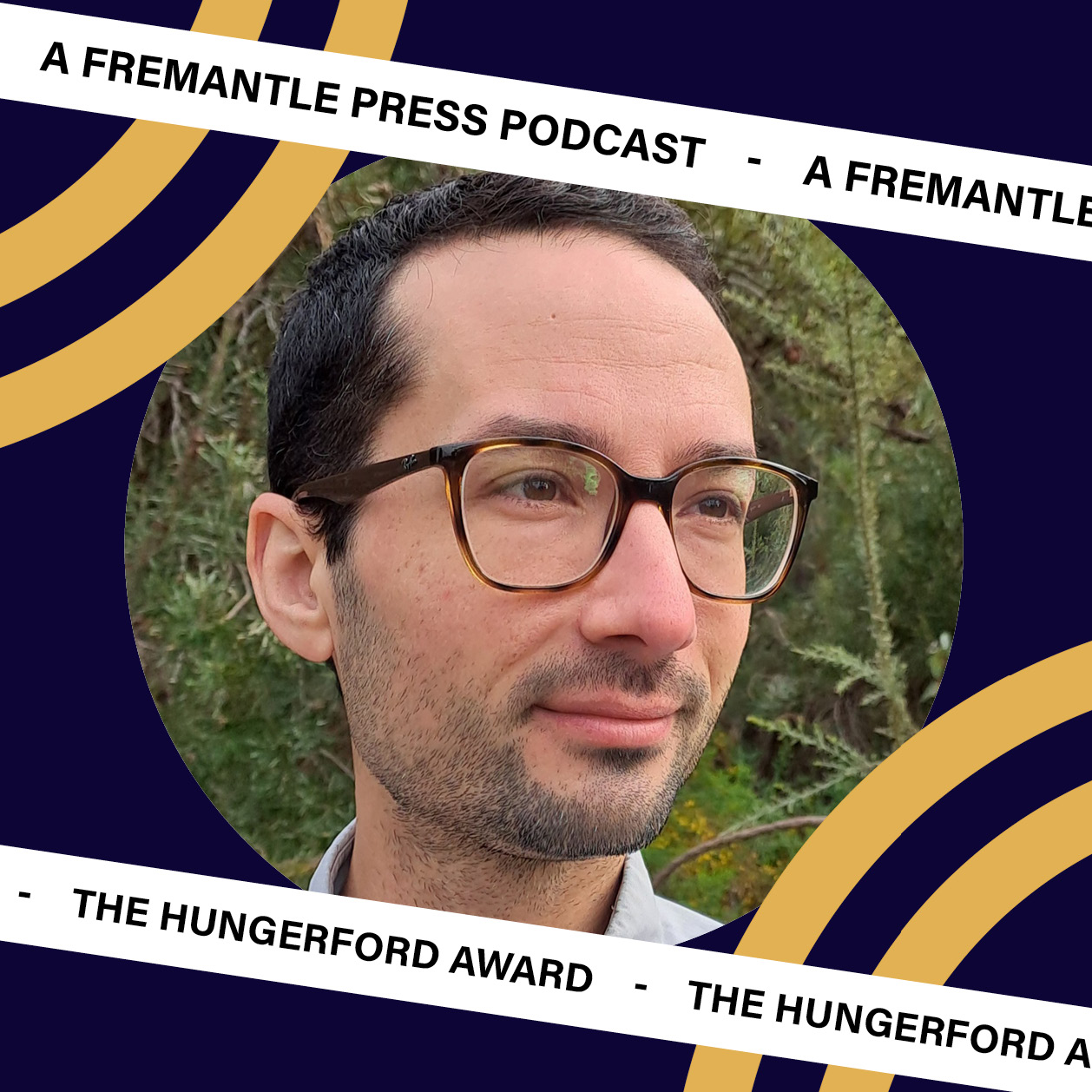
Today's guest is Greg Taylor, whose manuscript is a collection of narrative essays called Wildlife of the Open Eucalyptus Forests.
First up, Kate, could you describe why you and the judges chose this manuscript for the shortlist?
[00:00:59] Speaker A: Yeah. Thanks, Holden. These essays each focus on one particular creature or critter who lives in the open eucalyptus forests of Australia.
You couldn't get more subjective in seeing the world from the point of view of a single trapdoor spider or a thylacine. And this is the collection's great charm. The way that Greg has created these 24 stories creates empathy. And this total immersion in somebody else's world makes you think about the natural world differently.
We're all creatures with an equal stake in the future of the planet. We were relieved that the book also ends on a hopeful note, because the world that Greg Taylor writes about is definitely a world we would want to help save.
[00:01:36] Speaker B: Thank you so much, Kate, for those comments.
Now to introduce our guest author for today's podcast.
Greg is an ecologist specialising in the behavioural ecology of birds. While earning little to no money, he has variously stalked superb fairy wrens at the foot of the Great Dividing Range, captured black legged kittiwakes atop an abandoned radio tower on an island off the coast of Alaska, chased Caspian terns from the ocean to the desert, planted robotic eggs inside the nests of Forster's terns, and tagged giant kangaroo rats in the largest grassland remnant of California's San Joaquin Valley. He is a passionate birder with a Life list of 526 species, not that anyone is counting. He lives in Perth. Greg, welcome to the podcast.
[00:02:24] Speaker C: Thank you.
[00:02:26] Speaker B: Congratulations on getting this far. It's a huge accomplishment. How are you feeling?
[00:02:31] Speaker C: Excited. It's a bit surreal.
[00:02:32] Speaker A: Yep.
[00:02:33] Speaker C: Yep. I'm glad I got to hear Holden shepherd say kittiwake.
[00:02:36] Speaker B: So, did I pronounce it right? I hope I did.
I know very little about birds, so if I had a list, I think it's like three, probably. So.526 sounds very, very impressive.
Now, an award like this is a really impressive milestone. What was it like to discover that you were on the Hungerford Award shortlist?
[00:02:55] Speaker C: It was definitely very moving. I think when I had submitted my manuscript, I felt slash worried that I had written something that was very specific and that was written for a very specific audience, namely animal wildlife nerds like myself.
So, yeah, when I found out that I had been shortlisted, it definitely made me take a step back, back and realize that there's something about these species stories that does resonate with a broader audience than I had originally anticipated. It's very much an honor to have the chance to potentially be able to share these stories with everyone, particularly when so many of these stories belong to vulnerable voices that so often go unheard.
[00:03:37] Speaker B: It's certainly, I don't think, one of those things that's too niche. I felt Invisible Boys was too niche. And what you find is readers will connect with all kinds of aspects of humanity and nature and writing. So very exciting for audiences to get to find out out more about your story, could you tell us in your own words what your manuscript is about?
[00:03:55] Speaker C: So this is a collection of 24 narrative essays, and these tell the stories of 24 species that inhabit the open eucalyptus forests. These are the forests that surround not just Perth, but many of Australia's capital cities. And these are animals like black cockatoos and echidnas and numbats. Many of the chapters are fairly straightforward stories of an individual over the course of one day or going over the course of a year or a lifetime.
And some of the chapters also touch on issues of conservation. And then there are also some chapters that tie in a bit of mythology to help tell these species stories.
[00:04:35] Speaker B: Really powerful to see their stories kind of from their perspective in a way, which is quite an interesting technique. When you're ready, could you please share that reading from Wildlife of the Open Eucalyptus Forest and maybe just give us a little bit of an intro or a bit of context into where this segment fits into the book.
[00:04:52] Speaker C: I'm telling the story of a trapdoor spider.
She slips out of the egg and into the world.
The world is a vertical shaft, 4cm across and 70 deep.
Despite her excellent eyesight, she can see neither to the top nor to the bottom. Both are hidden in darkness.
Clinging to the middle of the shaft, she grips a woven wall of silken strands with the tips of her legs, her tarsi.
Slowly, she crawls upward, carefully placing one leg at a time, moving along the countless threads that cross one another in such a dense array as to be called a tapestry.
Then the tapestry speaks and she freezes.
Deep thrums jar her foremost tarsi. Then her hindmost.
Something ahead, looming, fills the width of the burrow with its great bulk. Look. Closer it comes. Thrum, thrum, thrum. Suddenly it's here. The hatchling raises her front pair of legs, placing them with utmost tenderness against the vastly larger leg that has, like a temple column, come down out of the darkness before her mother.
By the following day, the hatchling is joined by 39 siblings. They are arranged to all of them in perfect stillness, in perfect silence around the silk strung walls of the burrow, facing downward together, as though enthralled to the unseen presence that has now positioned itself beneath them.
Mother, looking upward as at the advent of 40 angels, returns the unseen stare of her motionless brood.
They spend the next six months like this, acolytes waiting for a sign from God. God waiting for a sign from the heavens.
At the start of April, she receives it.
Raindrops drum on the surface of the earth, sending low frequency declarations to Mother's tarsai. It is time. It is time. It is time.
Mother ascends and her children follow.
At the burrow's apex, the hatchlings watch as Mother uses her great strength to lift the lid off the world, a clay plug that she constructed before the start of time.
Outside conditions appear similar to those within the burrow. Dark, humid, mild. As though their home opens on to nothing so much as another larger burrow. It beckons to Mother. Children, the time is now. The rain filled darkness whispers. Quickly, quickly. It is time. It is time.
40 spiderlings stream past their mother, brushing against her legs as they rush to meet their fate.
Fanning out, they scramble through the leaf litter, each looking for the place that will call home for the rest of its life.
Some cease their wandering almost as soon as they have started. Just centimeters from their birth burrow from Mother.
Others travel whole meters.
Some settle near one another, so close that they can feel with their tarsi, the busy digging of their brothers and sisters.
Others settle far from any siblings.
In the morning, a gray dawn creeps over the horizon. And any spiderlings that have not dug and hidden themselves within burrows are swiftly picked off by scrub wrens and fairy wrens.
Over the coming days and weeks, many more spiderlings will lose their lives, but not to birds, those that burrowed within Mother's killing fields. The space within 10 centimeters or so of her burrow will be indiscriminately eaten by her, rejoining her body as sustenance.
Those that burrowed within their siblings killing fields will likewise be cannibalized, becoming one another's first taste of flesh.
Our female spiderling journeyed far over the course of the long night and now lies hidden within a newly dug burrow all her own.
She is settled nearly 5 meters from mother and is far removed from any siblings.
She is isolated.
She is safe.
[00:08:55] Speaker B: Greg, thank you so much for that beautifully rendered reading.
Now, I want to ask a few questions of you. You're relatively new to Western Australia.
Do you think that makes you see the details of this environment differently? And did you have to do much research before you began writing?
[00:09:11] Speaker C: Yeah, so I definitely had to do a lot of research. I'm an ecologist, so I have a certain broad level of expertise. But I definitely wanted to be across all of the 24 species that I was going to cover in the book. Typically chapter, I would go and read a few dozen scientific papers on things like behavior, ecology, species conservation, and then I would get to go out and do the fun stuff. So I traveled across Southwest wa, up toward Geraldton, over to Dryandra, across the Jarrah Forest, and spent hundreds of hours really gaining a deep familiarity with many of the species that I include in the book. Wanted to make sure that I felt ready to.
[00:09:50] Speaker B: To tell their stories as someone with that scientific background as well. Within Australia, and maybe especially Western Australia, we love to think that, like, every species here can kill and we're kind of a bit proud of that. Is that true?
[00:10:03] Speaker C: I feel that it's been a bit overblown. As someone who is not from here and has not been in Perth for very long, although I've been in other parts of Australia, I don't know, there really aren't that many snakes. Like the spiders are fine.
Yeah, I don't know. I mean, I mean, I'm all for, like, nature being deadly and killing, really I am, but I feel that it could do a lot better. Really?
[00:10:27] Speaker B: Look, that's an absolutely heartbreaking myth to have busted right in front of my own eyes. I almost regret asking, but thank you for the scientific truth. Now, do you have any hope of offering people some level of comfort or optimism when we're mourning kind of the loss of biodiversity, you know, what do you think we can still do in this space in where we are now in 2026?
[00:10:48] Speaker C: One of the big things relates to protected areas so broadly across Australia, but also particularly within wa, Our protected areas tend to be in the arid desert interior and in these places, there typically are not threats like development or industry.
And so it's really important when we are establishing protected areas to remember that we need to protect those areas, those places and those habitats that do face threats.
And we need protected areas that protect a place from something. For me personally, hope is something that I have to create actively within myself.
And the way that I do that is through not purchasing or consuming animal products or through donating to conservation organizations or of course through writing.
[00:11:44] Speaker B: It's so important and you're absolutely spot on that writing is a form of that advocacy or spreading the message and raising awareness through a whole range to a whole range of new listeners and readers.
Greg and Kate, thank you both for being here. And Greg, thank you for sharing more from your manuscript Wildlife of the Open Eucalyptus Forests. Listeners, you can meet Greg at the 2026 Hungerford Award announcement at Wolulup Civic Center, City of Fremantle Town hall on Friday the 16th of Oct.
Tickets are free and available from the Fremantle Press website. I'm Holden shepherd, thank you for listening.